


Vacuum Casting
复膜1
Quantity
What Is Vacuum Casting?
Polyurethane vacuum casting is a specialized technique for making high-fidelity copies of master patterns using inexpensive silicone molds and pourable casting resins. Copies made in this way demonstrate the same quality as plastic injection molded parts while taking only a fraction of the time and expense to produce.
Vacuum Casting Service
We offer a complete turnkey solution for creating master patterns and cast copies based on your CAD designs. We not only make high-quality molds but we also offer a full line of finishing services including painting, sanding, pad printing and more. We’ll help you create parts for showroom quality display models, engineering test samples, crowdfunding campaigns and more.
Do you need production quality plastic prototypes fast? Polyurethane vacuum casting may be the ideal solution for you. HY RP ’s vacuum casting service is renowned for producing showroom quality display models, engineering samples, crowdfunding prototypes and more. And of course all of your parts are expertly finished with professional painting, printing and machining.
Advantages Of Vacuum Casting
Low cost for molds
Molds can be made in a few days
Many types of polyurethane resins are available for casting, including overmolding
Cast copies are highly accurate with excellent surface texture
Molds are durable for 20 or more copies
Perfect for engineering models, samples, rapid prototypes, bridge to production
When to Use Vacuum Casting?
Product developers turn to vacuum casting when they need only a small volume, between 10 to 20 pieces, of production quality plastic parts while avoiding the long lead time and financial commitment of making plastic injection mold tools.
These parts are used for prototypes and display models, for crowdfunding and trade show campaigns, to test a new design for fit and function, and as a bridge to larger production volumes. Vacuum casting can also be used for end-use parts in some applications, since the pourable casting resin effectively mimics the performance of ABS, Nylon, PP, acrylic and soft TPE rubber.
Why Choose HY RP for Vacuum Casting Services?
When it comes to vacuum casting, there are a number of manufacturers to choose from. Choosing the right one is essential for getting exactly the results you expect. Here are several reasons to choose HY RP for your vacuum casting needs.
Exceptional Quality and Speed
Quality shouldn’t have to come at the expense of speed, and vice versa. At HY RP, we combine our extensive experience with the industry’s latest tools and technologies to deliver high-quality vacuum casting services on short timelines (typically in 7 to 14 days).
Finishing Services to Enhance Your Product
Vacuum casting isn’t all we do. As your one-stop production shop, we also offer a wide range of complementary finishing services to help your product come to life. Our finishing services include machining, media blasting, printing, painting and more.
Intelligent Quotations for Every Project
Your needs are unique — and you don’t want to pay for more than you need. That’s why we never require a minimum order volume or minimum dollar value for our vacuum casting services. We also use state-of-the-art AI quotation algorithms for fast, accurate quotes in 24 hours or fewer for nearly all projects.
Design for Manufacturing Support and Remote Flexibility
As vacuum casting is often used for prototyping, we know that many of the products we work on haven’t reached their final design. To help them get there, we provide detailed design for manufacturing support to our clients. (We can even make your patterns for you.) We also offer detailed video files showing all production steps for clients who can’t visit us in person.
Vacuum Casting Process
There are three steps to making polyurethane vacuum cast parts: making the master pattern, making molds and casting the parts.
Step 1. Master Patterns
Patterns are 3D solids of your CAD designs. They are usually made by CNC machining or with 3D plastic printing such as SLA/SLS. You can supply your own patterns or we can make them for you. Patterns need to be able to withstand heating to 40°C.
A master pattern can be any physical solid of your design. They are often made either by CNC machining or some form of 3D printing such as SLA. Note, however, that a pattern made from 3D printing will not be quite the same as the CNC counterpart, since the later process uses round cutting tools that cannot make very tight radius corners.
Step 2. Making the Molds
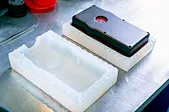
Casting molds are made from liquid silicone. This silicone is poured around the master pattern inside of a casting box, and then allowed to cure in an oven for 16 hours. Once dried, the mold is cut open and the master removed, leaving behind an empty cavity in the exact negative shape of the original.
First the pattern must be carefully prepared, and that means sanding and sealing the surface with primer. Once it’s ready, it’s placed into a casting box and liquid silicone is poured around it. Depending on the size of the part, it can take 12~24 hours to fully cure inside of an oven. Once dried, the mold is cut open and the master removed, leaving behind an empty cavity in the exact negative shape of the original.
Step 3. Casting Copies
Your choice of casting resins can now be poured into the empty cavity to create a highly accurate copy of the original. It’s even possible to overmold with two or more materials. Silicone molds are typically good for 20 or so copies of the master pattern.
Vacuum Casting Technical Specifications
Typical lead time: Up to 20 parts in 15 days or less, depends on the part specification and volumes.
Accurate: ± 0.3% (with lower limit on ± 0.3 mm on dimensions smaller than 100 mm)
Minimum wall thickness: To ensure that the mold is filled properly, a wall thickness of at least 0.75 mm is necessary. For best results, we recommend a wall thickness of at least 1.5 mm
Maximum part dimensions: The size of the mold is limited by the dimensions of the vacuum chamber (1900 x 900 x 750 mm) and by the volume of the product (maximum volume: 10 liters)
Typical quantities: Up to 25 copies per mold (depending on the mold’s complexity and the casting materials)
Color & Finishing: Pigment is added to the liquid polyurethane prior to casting, custom painting and texture.
Vacuum Casting Tolerances
The finished dimensions of vacuum cast parts are dependent on the accuracy of the master pattern, the part’s geometry and the type of casting material used. Generally a shrinkage rate of 0.15% is to be expected.
casting vacuum machine
vacuum die casting aluminium
Polyurethane vacuum casting is a specialized technique for making high-fidelity copies of master patterns using inexpensive silicone molds and pourable casting resins. Copies made in this way demonstrate the same quality as plastic injection molded parts while taking only a fraction of the time and expense to produce.
Vacuum Casting Service
We offer a complete turnkey solution for creating master patterns and cast copies based on your CAD designs. We not only make high-quality molds but we also offer a full line of finishing services including painting, sanding, pad printing and more. We’ll help you create parts for showroom quality display models, engineering test samples, crowdfunding campaigns and more.
Do you need production quality plastic prototypes fast? Polyurethane vacuum casting may be the ideal solution for you. HY RP ’s vacuum casting service is renowned for producing showroom quality display models, engineering samples, crowdfunding prototypes and more. And of course all of your parts are expertly finished with professional painting, printing and machining.
Advantages Of Vacuum Casting
Low cost for molds
Molds can be made in a few days
Many types of polyurethane resins are available for casting, including overmolding
Cast copies are highly accurate with excellent surface texture
Molds are durable for 20 or more copies
Perfect for engineering models, samples, rapid prototypes, bridge to production
When to Use Vacuum Casting?
Product developers turn to vacuum casting when they need only a small volume, between 10 to 20 pieces, of production quality plastic parts while avoiding the long lead time and financial commitment of making plastic injection mold tools.
These parts are used for prototypes and display models, for crowdfunding and trade show campaigns, to test a new design for fit and function, and as a bridge to larger production volumes. Vacuum casting can also be used for end-use parts in some applications, since the pourable casting resin effectively mimics the performance of ABS, Nylon, PP, acrylic and soft TPE rubber.
Why Choose HY RP for Vacuum Casting Services?
When it comes to vacuum casting, there are a number of manufacturers to choose from. Choosing the right one is essential for getting exactly the results you expect. Here are several reasons to choose HY RP for your vacuum casting needs.
Exceptional Quality and Speed
Quality shouldn’t have to come at the expense of speed, and vice versa. At HY RP, we combine our extensive experience with the industry’s latest tools and technologies to deliver high-quality vacuum casting services on short timelines (typically in 7 to 14 days).
Finishing Services to Enhance Your Product
Vacuum casting isn’t all we do. As your one-stop production shop, we also offer a wide range of complementary finishing services to help your product come to life. Our finishing services include machining, media blasting, printing, painting and more.
Intelligent Quotations for Every Project
Your needs are unique — and you don’t want to pay for more than you need. That’s why we never require a minimum order volume or minimum dollar value for our vacuum casting services. We also use state-of-the-art AI quotation algorithms for fast, accurate quotes in 24 hours or fewer for nearly all projects.
Design for Manufacturing Support and Remote Flexibility
As vacuum casting is often used for prototyping, we know that many of the products we work on haven’t reached their final design. To help them get there, we provide detailed design for manufacturing support to our clients. (We can even make your patterns for you.) We also offer detailed video files showing all production steps for clients who can’t visit us in person.
Vacuum Casting Process
There are three steps to making polyurethane vacuum cast parts: making the master pattern, making molds and casting the parts.
Step 1. Master Patterns
Patterns are 3D solids of your CAD designs. They are usually made by CNC machining or with 3D plastic printing such as SLA/SLS. You can supply your own patterns or we can make them for you. Patterns need to be able to withstand heating to 40°C.
A master pattern can be any physical solid of your design. They are often made either by CNC machining or some form of 3D printing such as SLA. Note, however, that a pattern made from 3D printing will not be quite the same as the CNC counterpart, since the later process uses round cutting tools that cannot make very tight radius corners.
Step 2. Making the Molds
Casting molds are made from liquid silicone. This silicone is poured around the master pattern inside of a casting box, and then allowed to cure in an oven for 16 hours. Once dried, the mold is cut open and the master removed, leaving behind an empty cavity in the exact negative shape of the original.
First the pattern must be carefully prepared, and that means sanding and sealing the surface with primer. Once it’s ready, it’s placed into a casting box and liquid silicone is poured around it. Depending on the size of the part, it can take 12~24 hours to fully cure inside of an oven. Once dried, the mold is cut open and the master removed, leaving behind an empty cavity in the exact negative shape of the original.
Step 3. Casting Copies
Your choice of casting resins can now be poured into the empty cavity to create a highly accurate copy of the original. It’s even possible to overmold with two or more materials. Silicone molds are typically good for 20 or so copies of the master pattern.
Vacuum Casting Technical Specifications
Typical lead time: Up to 20 parts in 15 days or less, depends on the part specification and volumes.
Accurate: ± 0.3% (with lower limit on ± 0.3 mm on dimensions smaller than 100 mm)
Minimum wall thickness: To ensure that the mold is filled properly, a wall thickness of at least 0.75 mm is necessary. For best results, we recommend a wall thickness of at least 1.5 mm
Maximum part dimensions: The size of the mold is limited by the dimensions of the vacuum chamber (1900 x 900 x 750 mm) and by the volume of the product (maximum volume: 10 liters)
Typical quantities: Up to 25 copies per mold (depending on the mold’s complexity and the casting materials)
Color & Finishing: Pigment is added to the liquid polyurethane prior to casting, custom painting and texture.
Vacuum Casting Tolerances
The finished dimensions of vacuum cast parts are dependent on the accuracy of the master pattern, the part’s geometry and the type of casting material used. Generally a shrinkage rate of 0.15% is to be expected.
casting vacuum machine
vacuum die casting aluminium